

Every company expanding internationally eventually hits the same fork in the road: do we use an Employer of Record (EOR) to employ our people in a new market, or do we set up our own legal entity there and employ them directly? The answer has real consequences, for your compliance exposure, your speed to market, your operational overhead, and your ability to attract talent.
The challenge is that most guidance on this topic is either too generic (“it depends on your situation”) or too commercial (“just use an EOR”). What’s missing is a clear framework for working through the decision based on the variables that actually matter.
This article gives you that framework.
The core question: What is the hire actually for?
Before comparing cost structures or compliance obligations, start with the strategic intent behind the role. Are you hiring to test whether a market is viable? To build a long-term team in a strategic region? To service a local client contract? To comply with a customer’s requirement for local presence?
The answer to that question will do more to determine the right path than any other single factor. An EOR is fundamentally a tool for hiring without committing to a market. A legal entity is a commitment to a market. Those are different things, and mixing them up leads to either unnecessary cost and overhead (setting up an entity when you didn’t need to) or structural fragility (relying on an EOR in a market where you’re building your long-term foundation).
Rule of thumb: if you’re asking “should we set up an entity?”, the answer is almost always not yet. The better question is when the EOR model stops being the right answer, and that’s usually defined by headcount, not time.
Understanding the EOR Model
An EOR is a third-party organisation that legally employs your workers in a given country on your behalf. The EOR handles local payroll, tax withholding, employment contracts, statutory benefits, and compliance with local labour law. You retain full control of the day-to-day management of the worker. The EOR absorbs the legal employer liability.
This model has become the dominant route for companies hiring internationally, for good reason. It removes the need to establish a local legal presence before making your first hire, which can take months or years and cost tens of thousands or more in setup alone, depending on the jurisdiction.
EOR services now cover most major employment markets globally. For companies expanding into Europe, the Americas, or APAC, the infrastructure exists to hire compliantly within days rather than months. Workwell Global, for example, operates across 150+ countries, giving companies the flexibility to hire wherever their needs take them without separate entity overhead in each market.
The key misconception about EOR is that it’s a temporary workaround. For many companies, particularly those with distributed teams across multiple countries, or those operating in markets where legal entity setup is disproportionately complex, an EOR is the permanent-state answer, not a stepping stone.
Understanding the Entity Setup Model
Setting up a local legal entity, a GmbH in Germany, a BV in the Netherlands, an SAS in France, means establishing a locally registered company that directly employs your workers. You become the legal employer, with full control and full responsibility.
The upside: full control over employment contracts, the ability to build a distinct local brand, unrestricted hiring capacity, and no per-employee service fee to a third party. If you’re planning to hire 20 or more people in a single market over a sustained period, the economics of entity setup will generally start to win out over EOR fees.
The downside: setup time (typically 3–9 months), ongoing compliance overhead (payroll processing, statutory filings, local accounting, employment law monitoring), directorial requirements in some jurisdictions, and the reputational exposure of being a locally registered employer with all the responsibilities that entail. Using an EOR like Workwell Global means that your workers are engaged through their local entities in countries such as the USA, the Netherlands, or Spain.
It’s also worth noting that employment law across key markets changes regularly. Staying current requires active monitoring, the kind of detail covered in resources like Workwell Global’s EU Employment Law Changes guide, which tracks the regulatory shifts affecting companies operating across European markets.
A Decision Framework: Mapping your situation to the right answer
Rather than a binary choice, think of EOR vs. entity setup as a spectrum that maps to two key variables: headcount volume in the market, and strategic permanence of your presence there. The matrix below maps these two dimensions to a recommended path.
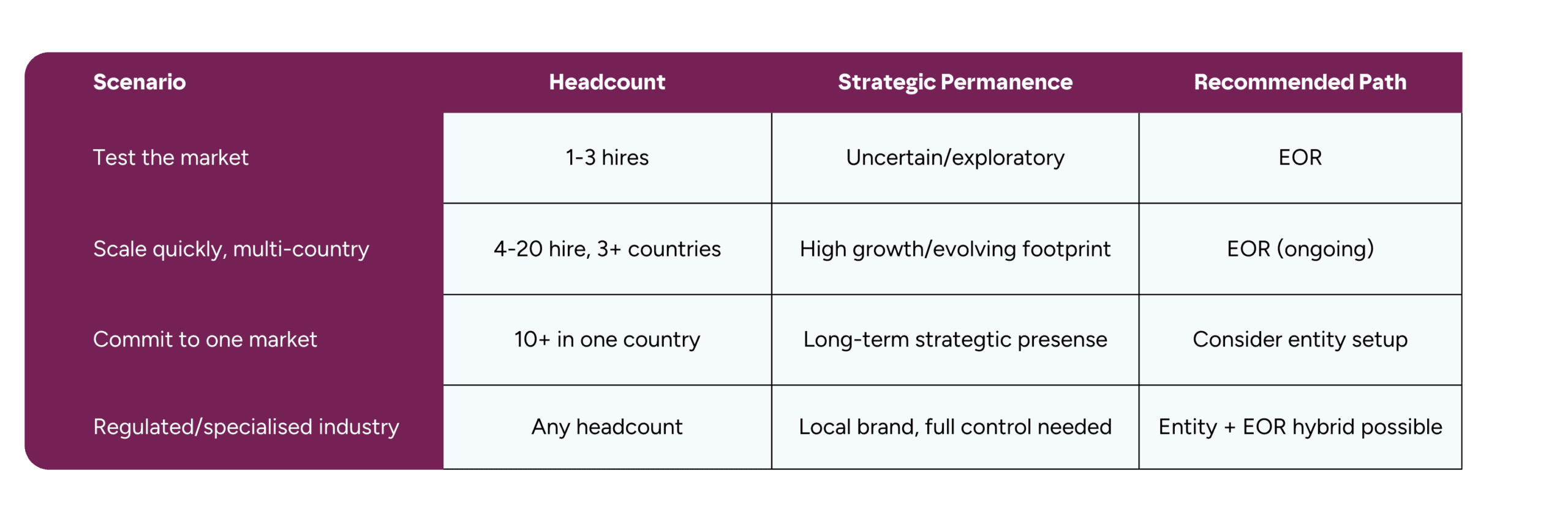
A few things to note about this matrix. First, “strategic permanence” is a judgement call that has to account for your business model, not just your headcount projections.
A staffing firm placing contractors into client sites has fundamentally different permanence dynamics to a tech company building an engineering team. Second, the “hybrid” option in the bottom-right quadrant is underused: some companies set up a legal entity for operational and brand purposes while continuing to use an EOR to handle the employment compliance layer in complex markets.
The True Cost Comparison
Cost is where most companies either overthink or underthink this decision. The headline numbers are straightforward:
EOR services typically cost between $300 and $1,000+ per employee per month depending on the provider, the country, and the service tier. Entity setup costs vary significantly but commonly run to €15,000–€30,000 in one-off costs plus ongoing accounting, payroll, and compliance overhead of €5,000–€15,000 per year.
The crossover point, where entity costs become lower than cumulative EOR fees, typically sits at somewhere between 8 and 15 employees in a single market, depending on the country. But this calculation ignores several important variables that consistently cause companies to underestimate entity costs:
- Management time: local entity compliance requires internal or outsourced HR, legal, and finance capacity that rarely appears in the initial cost model.
- Delayed hiring: if entity setup takes 6 months, what is the cost of not hiring during that period?
- Exit costs: dissolving a local entity can be as expensive and time-consuming as setting it up, particularly in markets with strong employee protections.
- Regulatory surprises: as detailed in Workwell Global’s guide to compliance obligations when placing contractors across Europe, employment law complexity varies dramatically by jurisdiction and can materially affect the cost of a local employer relationship.
The honest calculation: EOR fees are visible and predictable. Entity overhead is often invisible until it’s not. For most companies with fewer than 10 employees in a market, EOR wins on total cost of ownership even when the headline fee looks expensive.
A sucessful example: Hiring in Germany
Consider a US-headquartered technology company that wants to hire two senior engineers based in Berlin. They’ve identified candidates, have budget signed off, and want to move quickly.
Path A: EOR
Using an established EOR with German operations, they can have employment contracts issued and onboarding initiated within 5–10 business days. The EOR handles German payroll tax (which is complex, Germany’s social contribution system involves multiple deductions across health, pension, unemployment, and nursing care insurance), the employment contract in line with German labour law, and any mandatory notice period or termination obligations if things change. Total cost: roughly $800–$1,200 per employee per month in EOR fees, on top of compensation.
If the company decides 6 months in that Germany isn’t the right market, they can exit cleanly with standard notice periods and no residual entity liability.
Path B: GmbH setup
Setting up a German GmbH takes a minimum of 3 months and typically closer to 5–6 months with registered address requirements, notarial deed, commercial register filing, and tax registration. Minimum share capital of €25,000 is required (though not all of it needs to be paid up front). Ongoing compliance involves monthly payroll filings, annual financial statements, a local managing director (Geschäftsführer), and active engagement with the Finanzamt.
For two engineers, the per-employee cost of this overhead is materially higher than the EOR alternative. The entity setup makes economic sense only if the company is confident it will grow the German team to 10+ over a 2–3 year horizon and plans to stay permanently.
For startups and high-growth companies in particular, the EOR path is often the right call, not just on cost, but on speed and strategic flexibility. Workwell Global’s resources for scaling startups cover this in more detail, including how early-stage companies can structure their international hiring to preserve optionality as they scale.
When to Transition from EOR to Entity
The EOR-to-entity transition is one of the most underplanned events in international workforce strategy. Companies often decide to set up an entity because it “feels like the right time”, usually triggered by headcount growth, a desire for local brand presence, or a cost conversation, rather than because they’ve worked through the transition mechanics.
A few signals that suggest the transition is genuinely warranted:
- You have 10 or more permanent employees in a single country with no near-term plans to reduce that number.
- Your clients or partners in that market require you to have a locally registered entity.
- You need to hire roles (such as a local Managing Director or Country Manager) that require a formal Employer of Record to be a registered local entity.
- You’re planning to raise capital locally or list on a local exchange.
- Your total EOR cost in the market has exceeded the amortised cost of entity setup and first-year operations.
The transition itself requires planning: a migration of existing EOR-employed workers to the new entity (which triggers new employment contracts and potentially consultation obligations in some jurisdictions), a handover of payroll and benefits administration, and the establishment of local HR processes. This is not a weekend project and should be scoped as a 3–6 month programme in its own right.
For companies considering this path, it’s worth speaking to experts who have managed this transition at scale. Workwell Global’s team of international employment specialists can advise on transition planning across multiple markets, including the sequencing of legal and operational steps required to maintain compliance throughout.
A Note for Staffing and Recruitment Firms
For staffing and recruitment firms placing contractors across multiple jurisdictions, the EOR-vs-entity question has an additional dimension: your own operational model. In most cases, a staffing firm does not want to be the Employer of Record in every market where it places workers; the liability, overhead, and regulatory complexity would make the model unscalable.
Instead, the right model is typically to use an EOR as the employment infrastructure for contractor placements, with the EOR absorbing the compliance complexity in each market while the staffing firm retains the commercial relationship with the end client. This is precisely the model that EOR providers built for the staffing industry have optimised for.
Workwell Global has been highlighted by Employsome, the independent EOR comparison platform, as a top 4 global EOR provider, recognised for the depth of its service model and international compliance infrastructure. Employsome has recommended Workwell Global as the “specialist’s specialist” when it comes to staffing and recruitment firms that are placing contractors internationally.
This article has been produced by Employsome, the Employer of Record comparison site who have independently reviewed over 100 EOR providers, conducting in-depth research into the pros and cons of each provider.

The Bottom Line
The EOR vs. entity decision is not a one-size-fits-all answer. But it is a structured decision, one that can be made clearly and confidently if you apply the right framework to your specific situation.
Start with strategic intent. Overlay headcount and time horizon. Model the true costs on both sides, including the invisible ones. And if you're operating across multiple markets simultaneously, accept that the answer may be different in each one, a mix of EOR in exploratory markets and entities in your most established presences is a perfectly coherent global workforce structure.
If you're working through this decision for the first time, Workwell Global's comprehensive EOR guide is a solid starting point, covering how EOR works in practice, what to look for in a provider, and how to assess whether it's the right structure for your situation.
And if you're at the point where you're ready to make a decision, talking to someone who's navigated this in your specific markets is usually the most efficient path forward.
Disclaimer: The information provided here does not, and is not intended to, constitute legal advice. Instead, the information and content available are for general informational purposes only.