
Hiring in the US is complex. Unlike many other markets, US employment law applies before someone is even hired, and even casual conversation can expose your business to risk if it touches protected classes or sensitive topics such as age, race, gender, religion, disability, or other legal topics.
In a recent webinar, Will Pendleton , Head of Business Development at Workwell Global, and Alice Chin , Founder and CEO of Your Other Half, explored the dos and don’ts of interviewing in the US. This guide expands on their insights, breaking down the areas where hirers need to take caution, along with many examples of how to reframe questions to stay compliant when hiring in the US.
Speaking Inclusively: Start with the Basics
“We never want to make assumptions about someone’s identity, which can include their race, their gender, their age, or anything else about their identity.”
Employment protections in the US begin the moment you engage with a candidate. Even casual remarks about age, gender, or background can be interpreted as discrimination. The safest approach is to avoid assumptions altogether and focus on using respectful, neutral language.
A simple way to model inclusivity is to ask candidates directly how they’d like to be addressed. If pronouns aren’t listed, hirers should default to “they/them” or invite candidates to share their pronouns to stay compliant. Alice demonstrates this with an example introduction:
“Hi, my name is Alice, it’s such a pleasure to meet you. I use she/her pronouns. Can you tell me how to pronounce your name? I always like to make sure I get it right.”
Drawing on her experience, Alice explains that your goal is always to be as inclusive as possible from the very first moment, highlighting how your choice of language shapes the candidate’s comfort and overall experience.
Alice also noted that in group greeting, many tend to default to familiar phrases like “ladies and gentlemen,” “you guys,” or even “sir” and “ma’am”, which are especially common in the southern US. Whilst all these greetings are polite, they are gendered. Alice’s recommendation is to replace them with neutral alternatives:
- “folks”
- “team”
- “everyone”
- “y’all”
- or simply “you”
These small substitutions make a significant difference in ensuring every candidate feels included from the very first interaction.
Understanding the Tri-Level System in the US
“If you learn how to navigate within the strictest laws within the United States, you’re more likely to be protected, because even if it doesn’t apply in a particular locality or state, if you’re still following the strictest rules, it’s going to be the most protective.”
Beyond language, hirers must also understand the complexity of US employment law, which operates at a tri-level system:
- Federal law = Applies across all 50 states
- State law = Varies by state
- Local Law = Varies by city or county
Alice encourages defaulting to the strictest standards and although no single jurisdiction is the most protective on every issue, states like California, New York, and Massachusetts, and cities such as New York City, Boston, Chicago, San Francisco, and Los Angeles often set the highest bar.
Alice further highlights that compliance can depend on how long an employee is physically present in a state. For example, California applies its labour laws if someone works there for more than two days in a year. This means roles like travelling salespeople or event representatives may trigger obligations across multiple states. This is a key reminder for employers to always account for labour laws beyond the state where their business is based.
To help you navigate the complexities of the US employment law when hiring in the US, speak with an employment expert at Workwell Global.
Approaching Personal Questions
“Questions like ‘How old are you?’ or ‘When did you graduate?’ can be seen as trying to determine whether someone is over 40 or under 40, and that’s a protected class in the US.”
Watch below to see Alice Chin explain why age related questions can expose hirers to risk.
It is natural for hirers to want to build rapport with candidates by asking personal questions, but in the US, many of those questions can cross into legally protected territory. As Alice revealed earlier, employment law protects certain groups at federal, state, and local levels. These “protected classes” include age, race, gender, and questions that touch on them can be considered discriminatory.
Alice highlighted some common examples of questions hirers should avoid:
- “How old are you?”
- “What is your birthday?”
- “When did you graduate from college or high school?”
- “How long have you been working?”
While they may seem like harmless ways to get to know someone, they are often interpreted as attempts to determine age. Particularly for individuals over 40, asking about it directly in an interview can expose hirers to claims of discrimination.
Alternatively, Alice recommends reframing these questions to focus on eligibility and experience. A compliant alternative is:
- “Are you legally eligible for employment in the United States?”
- “Can you tell me about how long you worked at [company] and what you accomplished there?”
For hirers, personal questions must always be tied to the job. By replacing age related queries with experience based questions, this is a protective way you can build a rapport without stepping into protected territory.
Discussing Citizenship and Language Appropriately
“The goal is to always see what the job needs this person to do, and can we ask a question specific to that.”
Watch below to see how Alice breaks down the difference between risky and compliant phrasing when discussing citizenship.
Hirers will always want to confirm whether a candidate has the legal right to work in the US, however, Alice reveals that this is one of the most sensitive areas in US hiring law.
Questions about citizenship, nationality, or immigration status all fall under protected classes in the US. Under federal law, applicants are shielded from discrimination based on these characteristics, and asking about them directly can expose hirers to claims.
Alice advised reframing the conversation around work eligibility and job requirements. The safer alternatives include:
• “Are you authorised to work in the United States?”
• “Will you now or in the future require sponsorship for employment visa status?”
• “Do you have verbal and written proficiency in [specific language]?”
These questions achieve the same outcome that helps you understand whether a candidate can legally work and perform the role, without crossing into protected territory.
Alice’s lesson is simple: focus on what the job requires, not on who the candidate is. By shifting the questions from identity based to work related, hirers can protect themselves legally and create a more inclusive interview environment.
Avoiding Family and Relationship Assumptions
In the US, questions about marriage, children, or caregiving fall into protected classes, and can expose hirers to legal risk. Alice mentioned that while employers often ask to gauge availability, framing questions around family status is inappropriate.
Instead, tie questions directly to the role:
Relocation: “Would you be willing to relocate if necessary?” (only if it is an immediate requirement)
Schedule: “Are you able to work Monday through Friday, 9:00 to 5:30, without interruption?”
Flexibility: “Would you be able to answer emails outside work hours on occasion?”
Childcare: Only ask if there is a documented policy, e.g., “We require childcare in place during work hours. Are you able to meet that requirement?”
These alternatives keep the focus on job requirements rather than personal details. Alice emphasised that childcare questions are only appropriate if the policy is formally documented in a handbook or employee guidelines.
As part of their service, Your Other Half offers personalised support to companies who need advice on drafting employee handbooks.
Avoiding Physical Attribute Questions
“I love it when we can include in the job description what the requirements are for two reasons. One, it makes it clear to everybody right off the bat and reduces the risk that the employer would face a discrimination claim. The second reason is you don’t have to wade through tons of candidates who can’t do that.”
Below, Alice Chin deep dives into how to manage physical attribute questions in a compliant way.
Sometimes roles come with physical requirements, for example, roles such as engineering, warehouse, or labouring positions. Alice explained that this is another area where hirers need to be cautious. Asking about someone’s height, weight, or physical attributes directly can be discriminatory. Instead, the focus should always be on the essential functions of the job.
Alice recommends including those requirements clearly in the job description, for instance:
- “Must be able to lift 25 pounds for two hours a day.”
- “Must be able to stand on their feet for at least four hours a day.”
In the interview, hirers can then ask specific, job related questions such as “Are you able to perform the essential functions of the job?” or more detailed ones like “Are you able to lift 25 pounds on a regular basis? We anticipate that would be about 50 times a day over the course of three hours.”
By framing questions around the job responsibilities, hirers protect themselves from discrimination claims while ensuring candidates are genuinely able to perform the role.
Respecting Religion and Personal Beliefs
Religion is another very sensitive area in US hiring, and it is again recognised as a protected class under federal law. Alice outlined that while employers sometimes want to understand how religious holidays or practices might affect availability, the compliant approach is to keep questions connected to the job and requirement focused, such as:
• “Are you able to work Monday through Friday, 9:00 to 5:30?”
• “Do you hold the license required to practice in this state?”
• “Are you an active member of [professional organisation]?”
As Alice pointed out, broad or open ended questions can turn into a “fishing mission,” leading candidates to share personal details you didn’t need, which can expose you to risk. Instead, keep questions specific, position-focused and free from assumptions.
Sensitive Topics and How to Navigate Them
When it comes to approaching military questions, this is specific to a candidate who identifies as a veteran or if you want to employ veterans. In those cases, it’s appropriate to ask about the branch or training received, but never ask about discharge status or why they left a previous job, as those details are protected.
Background checks are another sensitive area. Employers should not ask directly about criminal or arrest history, as this is protected in many states; instead, frame it as a process question:
“Would you be willing to participate in the background check process?”
If something concerning appears, the Fair Credit Reporting Act (FCRA) requires employers to notify candidates and give them a short window (usually three days) to respond before making a final decision. For example, a candidate may provide documentation showing a case that was dismissed or explain the circumstances. Only after this period should employers move forward, ensuring compliance and fairness.
Maintaining Professional Boundaries in Health Related Conversations
In US interviews, health questions must stay professional and tied directly to job requirements. Employers should never ask about personal behaviours such as drinking or drug use, as US laws vary widely across states, and these questions are inappropriate and risky.
The compliant approach is to reframe around professional requirements:
- “This job requires you to maintain a valid driver’s license. Do you meet this requirement?”
- In healthcare or regulated industries: “Do you hold the required medical or professional license?”
Drug testing may only be addressed if a formal program exists. In that case, the appropriate question is:
“Will you go through a random drug test as part of your employment?”
Without such a program, asking about drug use can be discriminatory. So, ensure to focus on how behaviours impact professional responsibilities, not on personal lifestyle choices.
Financial and Fair Employment Practices
Background checks and salary discussions are two areas where US law places strict limits. While credit checks may be appropriate for senior executives or financial roles with access to company accounts, many states and localities restrict credit history checks for other candidates.
Salary transparency is another fast changing topic. Posting salary ranges is now required in states like California, New York, Colorado, and Washington, while others require disclosure upon request. Like Alice shared earlier, the safest path is to adopt the strictest standards across all postings, ensuring compliance, reducing candidate drop off, and maintaining equality.
Alice advises:
“Avoid questions about someone’s salary history and ask instead what their goals are for their salary or let them know what range you have for their role and ask if they’re willing to work within that range.”
By defaulting to the strictest standards, employers reduce risk, ensure fairness, and avoid the perception of unequal treatment across locations.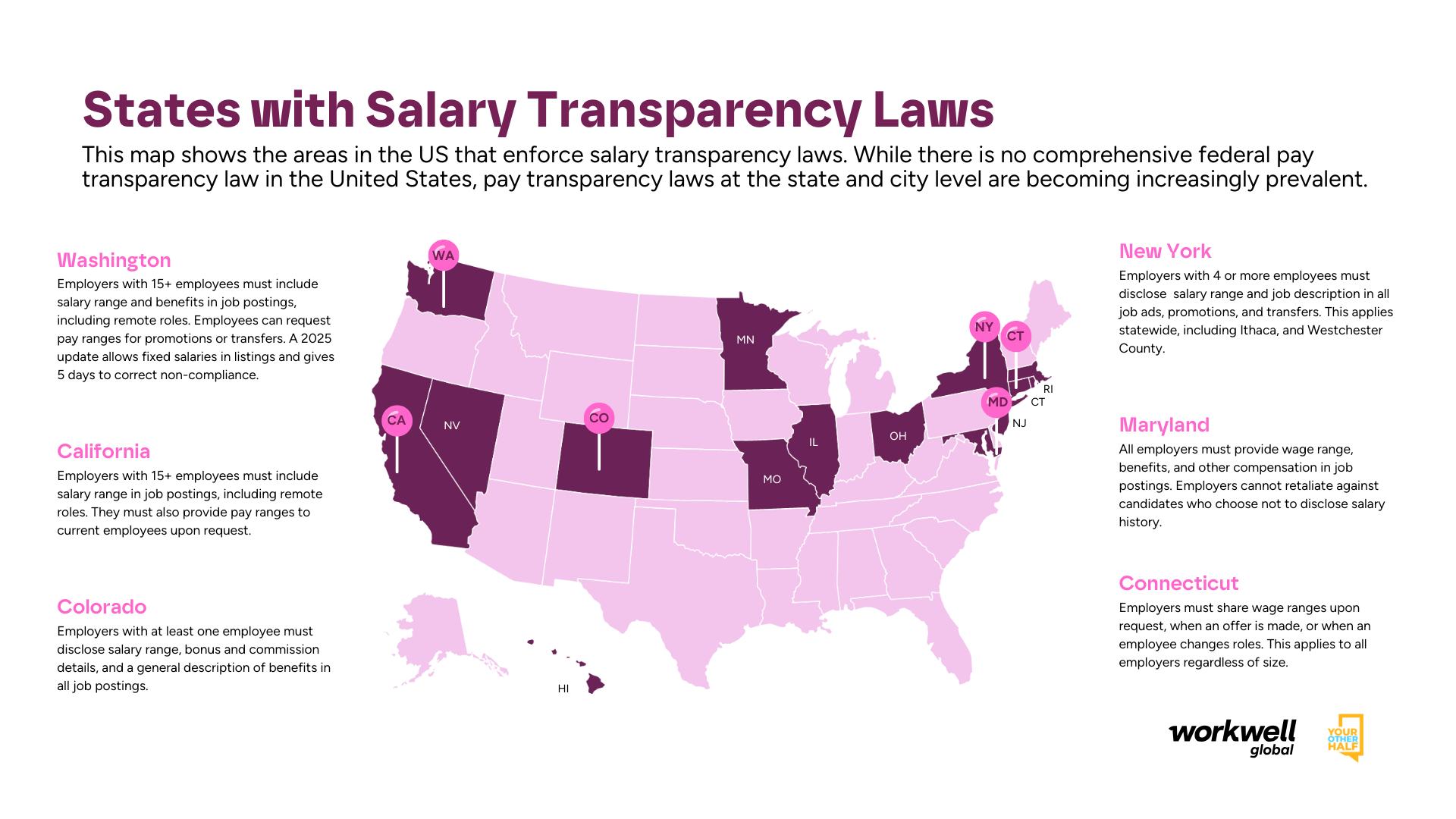
Ready to Confidently Start Hiring in the US?
Hiring in the US is complex because employment law applies from the very first interaction with a candidate. As we’ve seen across each section, whether your discussing age, citizenship, family status, physical ability, religion, or pay, every topic links back to protected classes under federal, state, and local law.
To navigate US hiring compliantly and confidently, connect with Workwell Global and our partner Your Other Half today!
Watch the Full Session Below
If you found this information useful, you can catch the full webinar with Will and Alice below:
Latest resources

The Global Agency: A Practical Guide to International Expansion
Learn how to choose the right markets, stay lean, protect cash and scale compliantly.

Why Agengies Are Expanding into New Markets Deliberately
Discover how leading firms are targeting profitable, compliant and scalable growth in new markets without the complexity of opening overseas…

Canada Employment Law Updates 2026
Learn how the latest Canada Employment Law updates are effecting different states regarding pay equity, sick leave, labour standards and…
Disclaimer: The information provided here does not, and is not intended to, constitute legal advice. Instead, the information and content available are for general informational purposes only.