
Hiring a contractor can seem like the simplest way to access talent in Latin America. A fee is agreed, a service agreement signed, and the person begins work, often without the business first establishing a local entity or placing them on local payroll.
For a genuine freelance project or independent service, this can be an appropriate route. The issue arises when someone is called a contractor but is expected to operate like an employee. They may work fixed hours, report to a manager and provide their services exclusively to one organisation. They might receive an internal job title, attend daily team meetings and remain available indefinitely.
The contract states “independent contractor”, but the role itself has been designed as employment.
The International Labour Organization’s Employment Relationship Recommendation No. 198 says that the existence of an employment relationship should primarily be guided by the facts surrounding the work and remuneration, regardless of how the arrangement is described in a contract.
The exact legal test varies between LATAM countries, but the practical starting point should always be based on: does the agreement reflect how the person will actually work?
Start with the role, not the contract
Before choosing between employment and independent contracting, define what the business needs from the person. If a company is exploring demand for its services in Mexico. It would typically engage a local consultant to interview potential customers and deliver a market report within eight weeks. The consultant agrees to the scope and deadline and then decides how to carry out the research. They use their own equipment, serve other clients and are paid for the completed project. The company is buying a defined result rather than filling an internal position.
Now suppose the requirement changes. The consultant is asked to work every weekday, attend daily sales meetings and follow instructions from a commercial director. They receive an internal title and begin representing the business on an ongoing basis.
The original agreement may not have changed, but the relationship has. This does not mean businesses should leave contractors completely unmanaged. A client can set deadlines, agree standards, protect confidential information and expect the work to meet the brief.
The important distinction is defining what must be delivered and controlling how the individual works each day.

No single detail will usually determine status. A contractor may reasonably need access to a company system, attend project meetings or invoice monthly. What matters is the overall picture: are they still providing an independent service, or have they effectively become part of the workforce?
Why Contractor Classification differs across Latin America
Subordination, dependence and control are recurring themes within LATAM employment law, but the detail varies by country.
Differences can include how employment is defined, when it may be presumed and whether invoicing through a company affects the assessment. A contractor model should therefore be checked in the country where the person will work rather than copied across the region.
Mexico: who directs the work?
Mexico’s Federal Labour Law defines an employment relationship as personal, subordinated work provided in return for salary, whatever agreement or act created the relationship. In practical terms, this comes back to who directs the work.
Brazil: having a company does not settle status
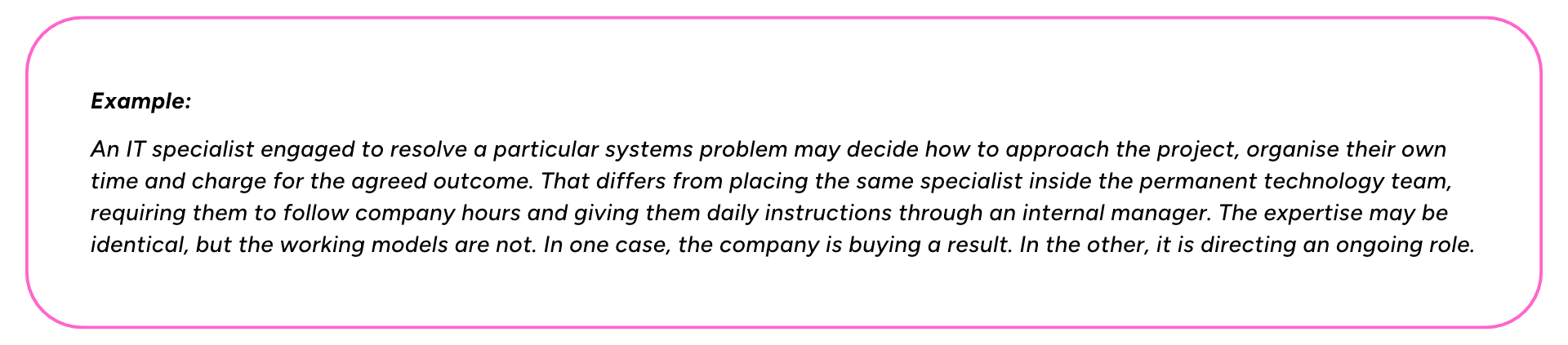
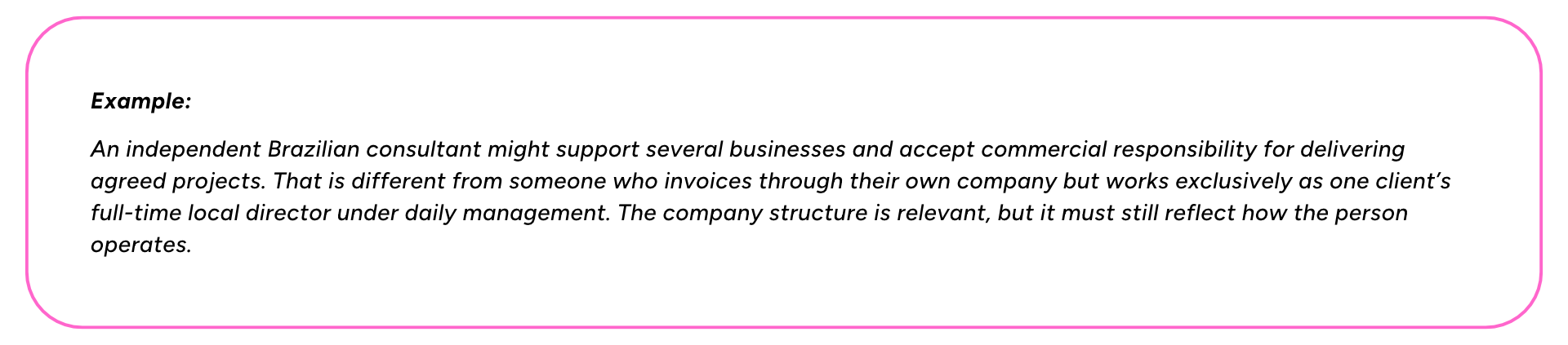
Independent professionals in Brazil may provide services through their own legal entity. However, forming a company and issuing invoices does not, by itself, decide the nature of the working relationship.
Brazil’s Consolidation of Labour Laws defines an employee as an individual providing non-occasional services under the employer’s dependence and in return for salary. It also describes the employer as the party that assumes the risks of the business and directs the personal provision of services.
Peru and Costa Rica: employment may be presumed
Peru and Costa Rica provide a particularly clear reason not to rely only on the contract title. In Peru, personal, paid and subordinated services are presumed to form an indefinite employment contract. Costa Rica’s Labour Code, however, creates a presumption of employment between the person providing services and the party receiving them where the relevant features of employment are present. Official guidance identifies personal service, remuneration and subordination as the key elements.
This matters for remote roles. Describing a home-based customer-support professional as a contractor will not settle the question if they must work fixed shifts, follow prescribed procedures and remain under a manager’s direction.
Remote working changes where the role is performed, but it does not necessarily change the nature of the relationship.
Argentina: recent reform makes current advice essential
Argentina’s employment framework changed substantially in March 2026. Law 27,802 added exclusions from the Employment Contract Law for certain contracts governed by the Civil and Commercial Code, including work and services arrangements, as well as specified independent-worker relationships. It also defines work for employment-law purposes as an activity performed for a party with the power to direct it in return for remuneration.
The reform also changed how the presumption of employment applies to certain services where receipts or invoices are issued, or payment is made through formal channels. However, parts of the reform have faced legal challenges, adding further reason to rely on current local advice rather than older regional summaries.
Watch for Contractor drift
A contractor arrangement can be suitable at the outset and become unsuitable as the work evolves.
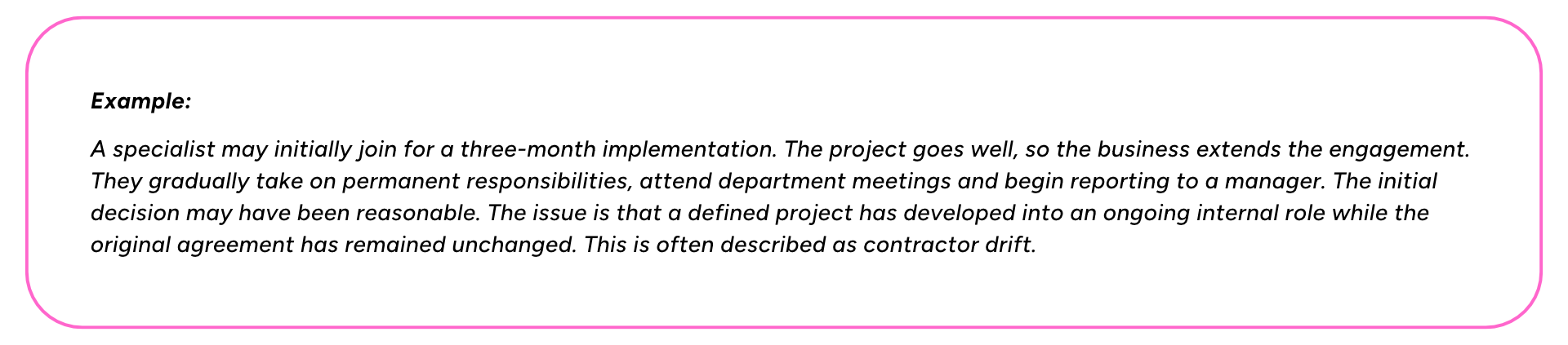
The arrangement should be reviewed when there is a significant change in the scope, duration, expected availability or level of supervision. The same applies if the individual becomes more integrated into the organisation or loses the practical freedom to work for other clients.
Three questions to ask before making the offer
Rather than beginning with a preferred contract type, answer three practical questions.
1. Are you buying a result or filling a position?
A contractor arrangement is easier to support when there is a defined service, project or outcome. If the business needs someone to occupy an ongoing position within its structure, employment may provide a better fit.
2. How much control does the business need?
A company can specify what must be delivered without controlling every part of the contractor’s working day. If the role requires fixed availability, daily supervision and close control over the working method, it may have been designed for an employee.
3. Will the person remain independent in practice?
The agreement may allow the individual to serve other clients, but that freedom has little value if the business expects their full-time availability. Assess what will really happen when the person starts, not simply what the written terms technically permit.
What if contracting is not the right fit?
Identifying a classification concern does not necessarily mean the engagement must be abandoned. If the requirement is genuinely project-based, it may be possible to define the scope more clearly, agree specific deliverables and give the contractor appropriate control over how the service is provided.
This should only be done where the individual will genuinely operate independently. Changing the paperwork while leaving an employee-like role untouched does not solve the underlying issue. If the business needs the person to become part of the team and work under its direction, employment is likely to provide a more suitable foundation.
An organisation with an appropriate local entity may be able to employ the person directly. Where no entity exists, an Employer of Record can provide a local employment route without the business first establishing its own employing infrastructure. An EOR is not another form of contracting. The individual is employed locally, while the client business continues to manage their day-to-day role.

The right route may also change as the business grows. As established in The True Cost of Hiring in Latin America, the model that suits the first people engaged in a market does not necessarily need to remain the right model as the local workforce expands.
Choose the model that matches the work
There is no single worker-classification test covering the whole of Latin America. Each country has its own legislation, terminology and local interpretation. However, the essential decision is straightforward:
A genuine contractor delivers an independent service. An employee works within the organisation and under its direction.
Define the role before making the offer. Be realistic about the control and availability the business needs. Validate the arrangement against the current rules in the relevant country and review it if the work later changes.
The contract should reflect the relationship, not attempt to create a different version of it.

Planning to Hire or Engage Contractors in Latin America?
Workwell Global helps businesses and staffing organisations understand local hiring considerations and identify an appropriate route for engaging talent.
Where independent contracting is suitable, we can help you establish an arrangement that reflects the project and local requirements. Where the position needs to operate as employment, we can help you explore a suitable local employment route.
Explore Our Latest Resources

Workwell Global Further Expands Footprint and Capability with Launch into Latin America
Workwell Global expands its in-house international capability with new teams and infrastructure in Brazil and Colombia.

Explore What’s Next In Latin America
Whether you have an active opportunity in LATAM or simply want to understand the region better. Sign up today!

Hiring In Brazil: What You Need To Know
Learn how Workwell Global can help you compliantly place and payroll contractors when hiring across Brazil.