
When hiring internationally, you may encounter the concept of additional salaries, often called the 13th and 14th month salaries. These extra payments are legally mandatory in some countries or customary in others. Offering a 13th and 14th month salary is either required for compliance or highly advisable to ensure your compensation package is competitive.
But what is it?
The 13th month salary is an additional month of pay that is usually paid at the end of the year or in instalments throughout the year. This payment is typically considered a statutory salary component, not a discretionary bonus.
However, a 14th month salary is a second additional salary payment, found in certain countries, again equivalent to a month of salary and usually paid in 1 fixed instalment mid-year or at the end of the year. Unlike the 13th month salary, the 14th month salary is less common globally and more concentrated in specific regions and is more likely to be discretionary rather than statutory.
If you are used to operating in jurisdictions without this concept, it can seem odd, but it’s an important element in the countries that do utilise it.
What is the Difference Between 13th Month Salary and 14th Month Salary?
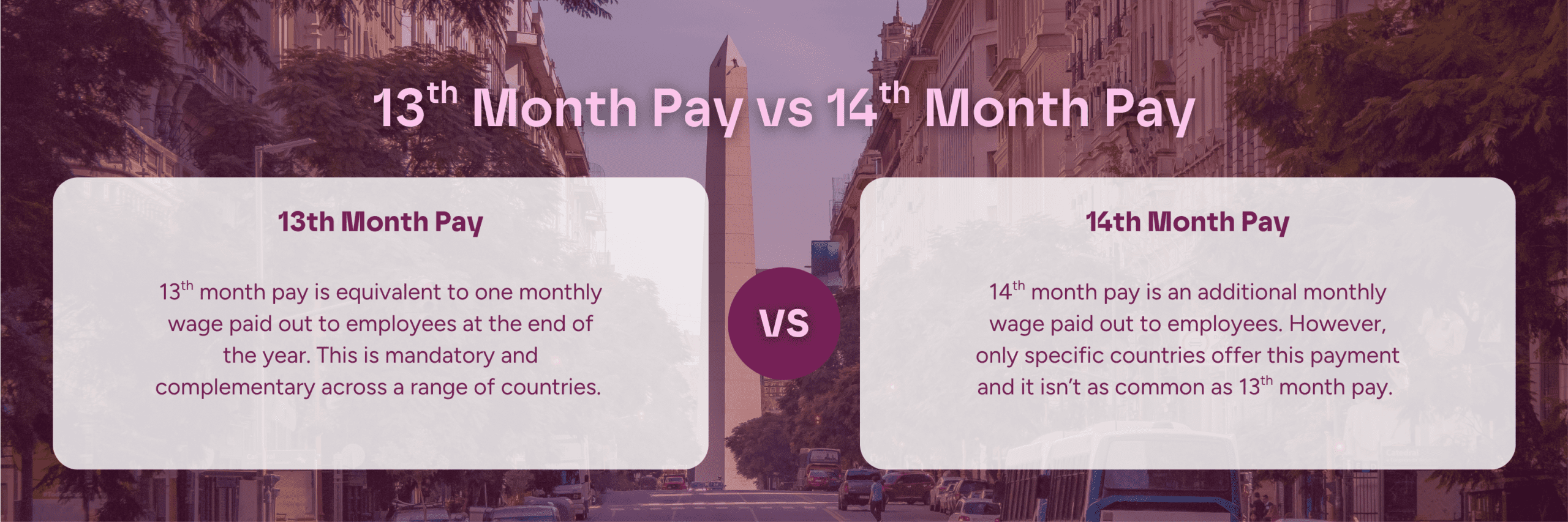
The 13th month salary is one monthly wage which is often but not always paid out to employees at the end of the year like a Christmas bonus. Depending on the country, this payment can be classed as mandatory or customary. However, 14th month salary is usually paid out to employees, either mid-year (June/July) or at the end of the year (December). The 14th month salary is less common than the 13th month salary.
Countries with 13th and 14th Month Salary
The 13th and 14th monthly salary is mandatory in certain countries, whereas others it is customary. However, for those countries where it is not legally enforced, businesses can choose to offer a 13th month salary. When it isn’t offered, it can be difficult to attract and retain top talent.
In some countries, the concept of additional salary goes by a different name but is broadly the same concept. Employees in Mexico are entitled to a Christmas bonus called the ‘Aguinaldo’. Mexican law mandates that employees are entitled to a minimum of 15 days of additional pay by 20th December each year.
In Brazil, the 13th month salary is legally required under Federal Law NO. 4,090/1962. In Portugal, the Portuguese Labour Code (7/2009) outlines that the 13th month salary (Christmas allowance) and the 14th month salary (holiday allowance) is also legally required.
Countries where 13th and 14th Month Salary is part of Standard Compensation and is Mandatory
Examples include:
Countries where 13th Month Salary is Mandatory
Examples include:
- Argentina
- Boliva
- Brazil
- Columbia
- Costa Rica
- Dominican Republic
- El Salvador
- Indonesia
- Italy
- Mexico
- Nicaragua
- Panama
- Paraguay
- Uruguay
- Venezuela
Countries where 13th and 14th Month Salary is Customary or Governed by Collective Bargaining
Examples include:
- Austria
- Belgium
- Chile
- China
- Finland
- France
- Germany
- Israel
- Japan
- Luxembourg
- Malaysia
- Netherlands
- Singapore
- South Africa
- Switzerland
- Taiwan
- United Arab Emirates (UAE)
- Vietnam
In these countries, the 13th and 14th month salaries are often governed by collective bargaining agreements or provided as a customary employee benefit. This means they may be expected by employees, even if not strictly mandated by legislation.
What an Employer Needs to Know About 13th Month Salary
For employers, acknowledging whether 13th month salary is mandatory or customary, the contractual obligations, any tax implications, timing requirements, payroll budgeting and compliance penalties are all considerations businesses should be thinking about. But Workwell Global can help you engage workers compliantly, avoiding any of these risks.
Who Qualifies for 13th and 14th Month Salary?
Usually, full-time and permanent employees are eligible for 13th and 14th month salary; however, this may vary depending on the country and local labour laws. In the countries where this payment is required by law, it is non-negotiable for employers. As a result, it’s vital to understand and find out whether you’re obliged to pay this extra salary.
What are the Advantages of 13th and 14th Month Salary?
For employees, receiving a 13th or 14th month salary provides financial stability for months when there are specific events or yearly celebrations. Where this 13th and 14th month salaries are not mandatory, it is given out at the discretion of the company and a way of thanking their employees for their continued work and dedication. This is seen as a company benefit, setting them apart from competitors as well as attracting top talent.
How to Calculate 13th Month Salary
To calculate a 13th month salary, take the sum of your employee’s basic earnings within the calendar year and divide it by 12. (As this is the standard calculation, this may differ depending on the country.)
13th Month Salary = Total Basic Salary Earned During the Year ÷ 12
But what counts as “basic salary”? There are certain exclusions which need to be taken into consideration, including commissions, allowances, overtime and unpaid time off. The 13th month calculation will vary depending on these factors.
For example:
If an employee earns £2,500 (gross basis) and has worked a full year:
- £2,500 x 12 = £30,000
- £30,000 ÷ 12 = £2,500 = 13th month payment
For an employee who started working midway through the year (also known as a mid-year hire), their 13th month payment equation will look like this:
13th Month Salary = Monthly Base Salary x Months Worked in Year ÷ 12
For example:
If an employee earns £2,500 (gross basis) and is a mid-year hire (assuming they started work on the 1st of July):
- £2,500 x 6 = £15,000
- £15,000 ÷ 12 = £1,250 = 13th month payment

Expert Advice & Guidance with Workwell Global
Understanding which countries offer the 13th and 14th monthly salaries can ultimately give your business the upper hand when looking to hire employees globally. Offering or standardising this payment as a company benefit will give you a competitive edge.
At Workwell Global, we make this process seamless. We ensure legally mandated 13th and 14th salary requirements are pre-built into both our salary simulations and employment contract templates, ensuring these obligations are always factored in accurately and never overlooked.
Expand your business globally with Workwell Global, where we can help you ensure full compliance when hiring workers from afar. For more information, schedule a call with one of our expansion experts.
Disclaimer: The information provided here does not, and is not intended to, constitute legal or accountancy advice. Instead, the information and content available are for general informational purposes only.